This post contains affiliate links.
Every dog should have a job
Which job is the hardest for dogs?
Is it police dog? Search and rescue dog? Detection dog? Herding dog? What do you think?
Would you believe me if I told you, it is the everyday, ordinary, often taken for granted, family dog??
Here is the truth about dogs and jobs… “working dogs” typically have one master. One person who is either an expert in the field of their dog’s trade or is training with an expert.
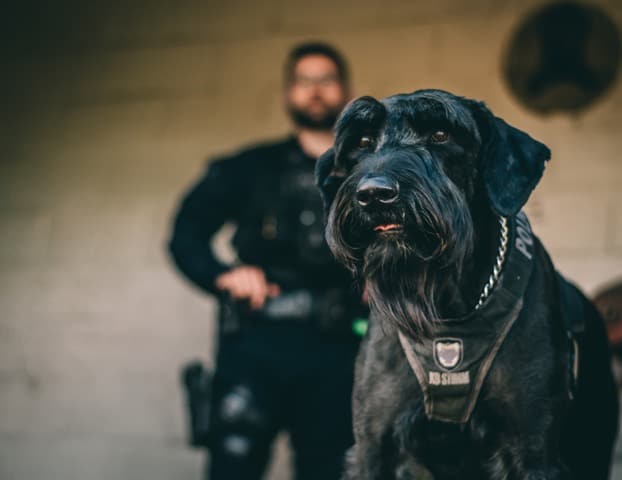
Most working dogs are produced from generations of carefully selected bloodlines, bred for their own particular strength in a specific job. There is both a consistency in type, and in training. The techniques and commands for working dogs are vast and varied depending on the type of work they’re training for. For instance, you would not expect a Border Collie herding sheep to understand the same commands a Giant Schnauzer would hear for hunting down a criminal.
This brings me to the “family dog” and the difficulty they face doing their particular job; being a good boy or girl.
The family dog has any number of masters to listen to. Mom says, “Get out of my kitchen!” Child says, “Leave my slippers alone!” Dad says, “Fetch my newspaper!” Talk about a whole bunch of mixed messages! What’s a poor dog to do?
Consistency is key!

For your family dog (be it a purebred from a breeder or an adoption from an animal shelter) to be a GOOD dog, there needs to be some consistency in handling and training. Commands need to mean the same thing from all members of the family, or the dog is going to be confused, and have a really hard time being a good dog.
So, if you’re getting a new puppy or older dog, or you’re having trouble getting your dog to listen to the entire family, it’s time for a meeting of the minds. All of the minds! Gather the children, the babysitter, the grandparents, and anyone else who tells the dog what to do. Get a white board or a chalk board and start brainstorming what commands your family will use for specific behaviours.
First, let’s explore the most commonly MIS-used commands.
Down & Come
Down
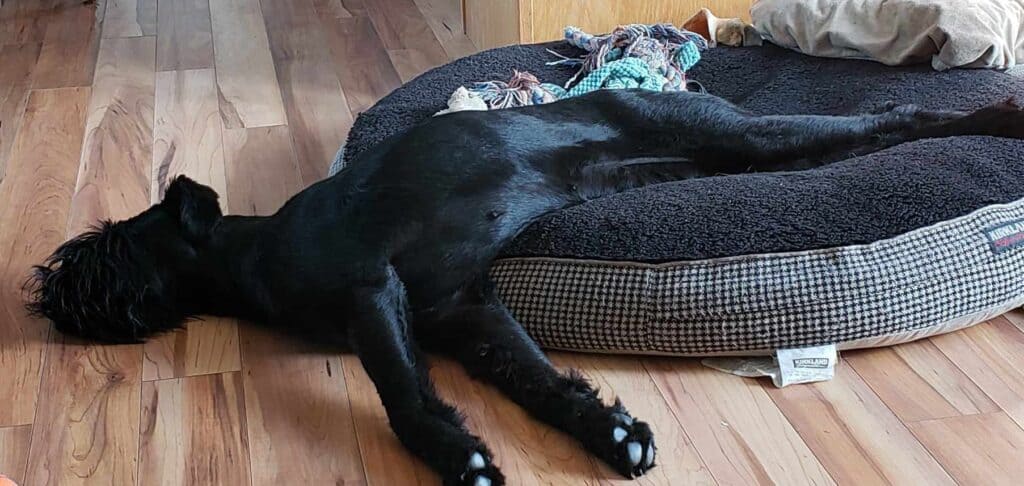
#1 DOWN – “geddown” “siddown” “goliedown” Sound familiar? It’s misused so often the dog actually has no idea what the word down means. In formal obedience training, the command Down means On Your Belly. Eventually in formal obedience training it means on your belly AND don’t move until the next command is given.
So, if your dog jumps on the neighbour when she comes for tea or gets on the sofa the minute your back is turned, the command is NOT “geddown!”
In fact, these two examples would have two different commands. Your dog should never jump on people, that’s a lawsuit waiting to happen. So for this this instance, the command should be a very firm NO! No = Never. Never, ever do this action. Whereas in the second instance, you might sometimes allow the dog on the furniture by invitation (we don’t advise it, but many do) so you wouldn’t use No or Down, you would use Off. Preferably offering the dog another solution, like Place (a specific place it’s trained to go to and stay) or less formally, “pillow” and show the dog its pillow as your preference where he should be.
Come
#2 COME – this word is misused because most times the word COME is given without follow through. The dog is sniffing around the yard, and you open the door and yell Come! More often than not, the dog will lift its head, then continue sniffing. You mutter “bad dog” under your breath and close the door. The dog has NOT come, the word means nothing.
Again, in formal obedience training, the command Come means stop whatever you’re doing, run to me as fast as you can, sit in front of me, look me in the eye, and wait for the next command. That’s a whole lot of information for one four-letter word. If you want your dog to reliable perform all of the above-mentioned steps, you must insist upon the complete performance each and every time.
I offer you an alternative. That said, let me explain the difference between formal and informal commands.
Formal commands are just that, specific commands for one specific action. Like: Down = On Your Belly. Nothing else ever. It’s not Sit Down, your dog can’t sit and down at the same time. Sit is its own formal command that means “bum on the ground.”

Informal commands are important as well, just not quite so precise. For instance, we use Here for the equivalent of Come. It still means return to me, but the rest is exempt. The dog should stop what it’s doing and trot on over to you. At that point you should praise the dog, then carry on with the next part of the process. That might be loading in the car, going into the house, or you just wanted to pat your good boy or girl.
Need some help? See our list of commands and what we use them for!
Basic Commands
Here is our list of most common formal and informal commands, and their meanings below. Make them work for all family members by agreeing on the terms and meanings so your dog isn’t confused.
| Formal | Informal |
| Down | Off or No |
| On your belly | Get off the furniture, Don’t jump, etc |
| Come | Here |
| Return to my front, wait for next command | Return to me, get a pat, go inside, etc |
| Stay | Wait |
| Don’t move from the position you’re in | At the door, top of the stairs, in the car etc |
| Sit | Sit |
| Bum on the ground | Same |
| Heel | With me or Let’s go |
| At my side, usually on the left | Going for a pleasure walk |
| Stand | Stand |
| Dog is on all four feet, not moving | Same, helpful for grooming, wiping paws etc |
| Out or Aus | Out or Aus |
| Let go of – anything your dog picks up… | … or has in its mouth |
Other helpful commands your family should be on board with:
Load, Crate, Kennel Choose one of these commands to clearly indicate you want your dog to be in a specific confined space.
Take, Bring, Give (or Out/Aus) A combination of commands helpful in formal dumbbell retrieve, training the dog to bring the newspaper, or just playing ball or frisbee.
Pillow, Bed, Place Can be formal or informal as is your preference. Many folks use Place as formal. We use Pillow or Floor for get away from the table, we’re eating. Beat It also works!
If you have any questions or comments, please reach out!
This post contains affiliate links.
Thanks Tammy! I think our family needs more work on knowing their commands than the dog! We very much appreciate your tips!
Exactly! 🙂 Consistency is the key. If everyone expects the same behaviour for the same word, the dog is less confused and everyone is happier!
Thanks for reading!